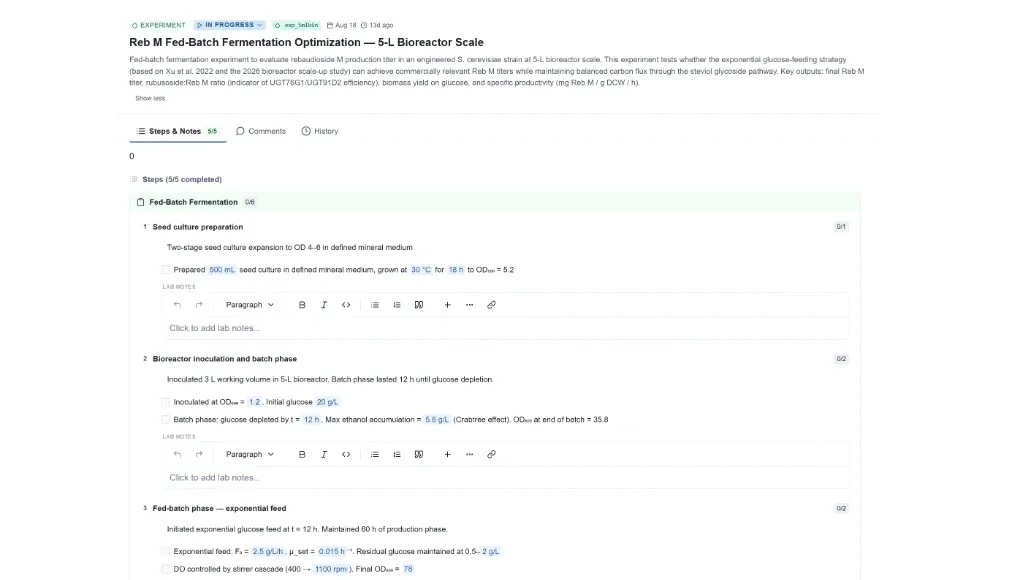
In Biocompile, decisions, dead ends and open questions are recorded on the project rather than in a chat log. You can search across every project your team has run, and see what was tried, why a condition was chosen, and what was already ruled out.
The file from last year is still there. Why you chose that condition, and what you already ruled out, is not. So the experiment gets run twice.
Why research reasoning never gets written down
Results get saved. Reasoning does not. It lives in a Slack thread, a meeting nobody minuted, or the head of the person who has since moved on.
In a 2018 survey of 1,001 US employees at organizations with 200 or more staff, run by Panopto and YouGov, roughly 42% of institutional knowledge was found to be unique to a single employee. When such a person leaves, the process understanding leaves with them.
What you record in Biocompile instead
- Record a decision in Biocompile when you make it, with the reason attached to the project.
- Mark a dead end as a dead end, so nobody walks into it again.
- Leave open questions open, where the next person can see them.
- Search across every project when you plan the next experiment.
What your team sees in Biocompile
- Who changed what, and whether it was a person or the assistant.
- Every claim linked to its evidence, with the caveats stated.
- A hash-chained audit trail, so tampering shows up.
- Nothing written to the record until someone approves it.
Why a recorded project compounds
A Biocompile project you come back to in three months still has its context. A colleague who joins next quarter inherits the reasoning, not just the outputs. The work gets more useful the longer the team runs it.
Frequently asked questions
How is this different from writing it all down in a shared drive?
A drive keeps the file. It does not keep the reasoning. In Biocompile a decision, a dead end and an open question are records attached to the project, so the next person finds why a choice was made, not only what the result was.
What happens when someone leaves the team?
The project keeps the trail. New colleagues inherit the full context of the work rather than a folder of outputs, and the audit trail shows who recorded what and when.
Does the assistant write into my project without asking?
No. Nothing enters your project record until you approve it, and every entry shows whether a person asserted it or the assistant proposed it.
Can I see where a conclusion came from?
Yes. Claims link to the evidence behind them, with the caveats stated, so a reader can follow a conclusion back to the file or paper it rests on.
In Biocompile, decisions, dead ends and open questions are recorded on the project rather than in a chat log. You can search across every project your team has run, and see what was tried, why a condition was chosen, and what was already ruled out.
Start for freeNo payment method required.
- How do I search literature and patents in one place and keep the sources?Biocompile searches PubMed, arXiv, bioRxiv, OpenAlex and Semantic Scholar alongside patents filtered by classification, assignee and country. Every answer links back to the source it came from, and the papers you keep stay with the project you are working in.
- How do I analyze my sequencing data without writing the pipeline myself?Upload your counts or results file to Biocompile and ask what you want to know in plain language. Biocompile writes and runs the analysis as real code in a private sandbox with Python, R and Bioconductor, and shows you the code and the plot it produced.